
Backlash is the Next Market
Mapping the biological sovereignty cycle and finding opportunities in emergent externalities.

The cost of sovereignty
Dreams of revolutionaries hoping to bring forth new modes of political sovereignty often end up corrupted into nightmarish new forms of tyranny.
Supporters of the French revolution believed that overthrowing the monarchy would usher in a new era of prosperity. These revolutionaries dreamed of a new sovereign republic that would defend and advance the ideals of liberty, equality, and fraternity. This dream quickly descended into a nightmare as power-hungry politicians filled the power vacuum with political violence, public executions, mass imprisonment, and dereliction of national defense. France’s reign of terror ended only with a military coup that centralized power first into the hands of three consuls and then ultimately into a single, dictatorial emperor: Napoleon.
Removal of the established structures that once preserved a system of sovereignty creates the ideal environment for new forms of domination to emerge.1 Devolution from idealistic revolution to tyrannical resolution is a common theme across history: 1917 Russia, 1979 Iran, 2003 Iraq, 2010 Egypt, and 2015 Myanmar are well-known examples but there are countless others.
Just as political sovereignty untethered from traditional structure can give rise to chaos, disillusionment, and new forms of oppression, so too can biological sovereignty. In the struggle to secure biological sovereignty for our species, our communities, and ourselves, we risk building new prisons that are less conspicuous but just as oppressive.
As a species, the technologies we build to free ourselves from environmental pressures often introduces new forms of biological tyranny. Similarly, the struggle to secure greater biological sovereignty from legacy institutions as communities and individuals also introduces new forms of oppression.
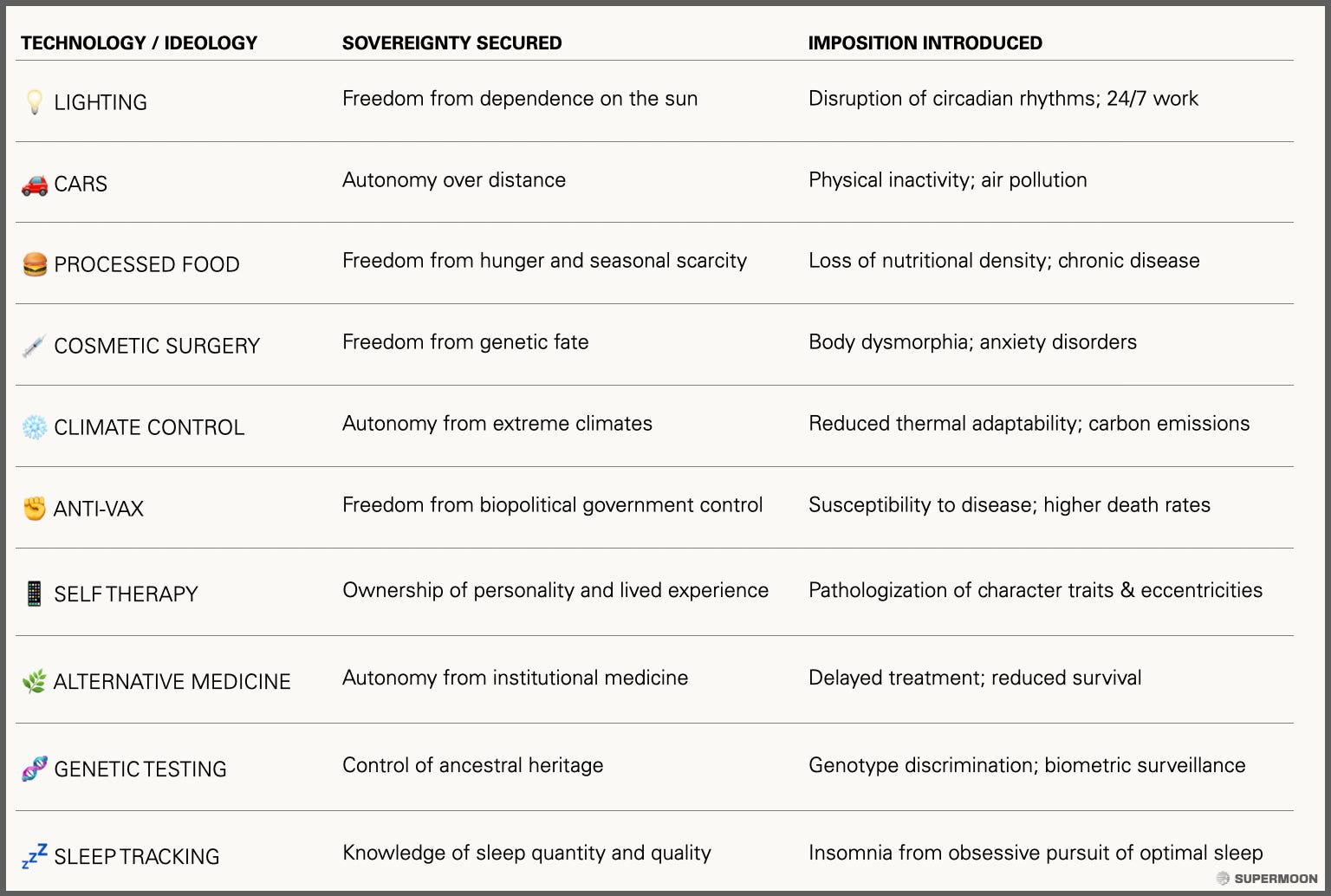
New technologies and ideologies help us claim biological sovereignty but simultaneously spark new sources of risks and constraints. These introduced impositions are often less imposing than the ones they replaced; many would argue that suffering from chronic disease is still better than dying from acute starvation. But better does not equate to good. Every answer still produces new questions.
We organize political systems and build technologies, they produce externalities, we correct them, and these efforts produce new challenges in the process.
Understanding sovereignty cycles
Cycles of sovereignty expansion and contraction are accelerating. Paradigm shifts occur more frequently as knowledge builds exponentially, systems become more interconnected, information loops tighten, and time between major innovations shrinks.
As these cycles accelerate, new value creation opportunities emerge more quickly and more frequently. Rapid technological deployment destabilizes traditional structures, introducing new demands, generating unintended consequences, and leaving needs unmet. Viral spread of ideology via memes and the greased tracks of internet media reshapes cultural landscapes far quicker than ever before, sparking new trends and advancing the velocity of new, serviceable consumer desires.
While paradigm shift acceleration amplifies new value creation opportunities, it simultaneously increases the difficulty of remaining valuable over consecutive shifts. Remaining embedded in the commercial infrastructure of an industry becomes increasingly harder as switching costs decrease, iteration speeds increase, and priorities shift. Cultural permanence is significantly harder to achieve as attention spans wane. The spotlight moves to the latest and greatest and environmental change introduces new behaviors. Futuristic innovation becomes more difficult when the future becomes more difficult to envision.
In this era of acceleration, it becomes increasingly important to identify where in the cycle a category sits. As seed investors, we seek to identify early signs of emergent externalities created by expanded promises of sovereignty. In other words, what frictions or failures are emerging for early adopters of a technology or early believers in a nascent ideology? These unintended consequences are likely to become the next established regime around which the next cycle revolves. We spend much of our time searching for health and wellness market categories that are entering the destabilization stage and identifying high-potential entrepreneurs from the early adopter cohort confronting emergent externalities.
Cycles of bio sovereignty are not just applicable to venture investors. For incumbents, understanding why the status quo is being challenged by new promises of expanded sovereignty may be the difference between enduring success and lost market share. For startups, understanding how backlash to emergent technology or ideology threatens continued growth may prevent customer churn and brand disillusionment. Regardless of occupational role or industry position, these questions should help guide allocation of resources for greatest ROI.
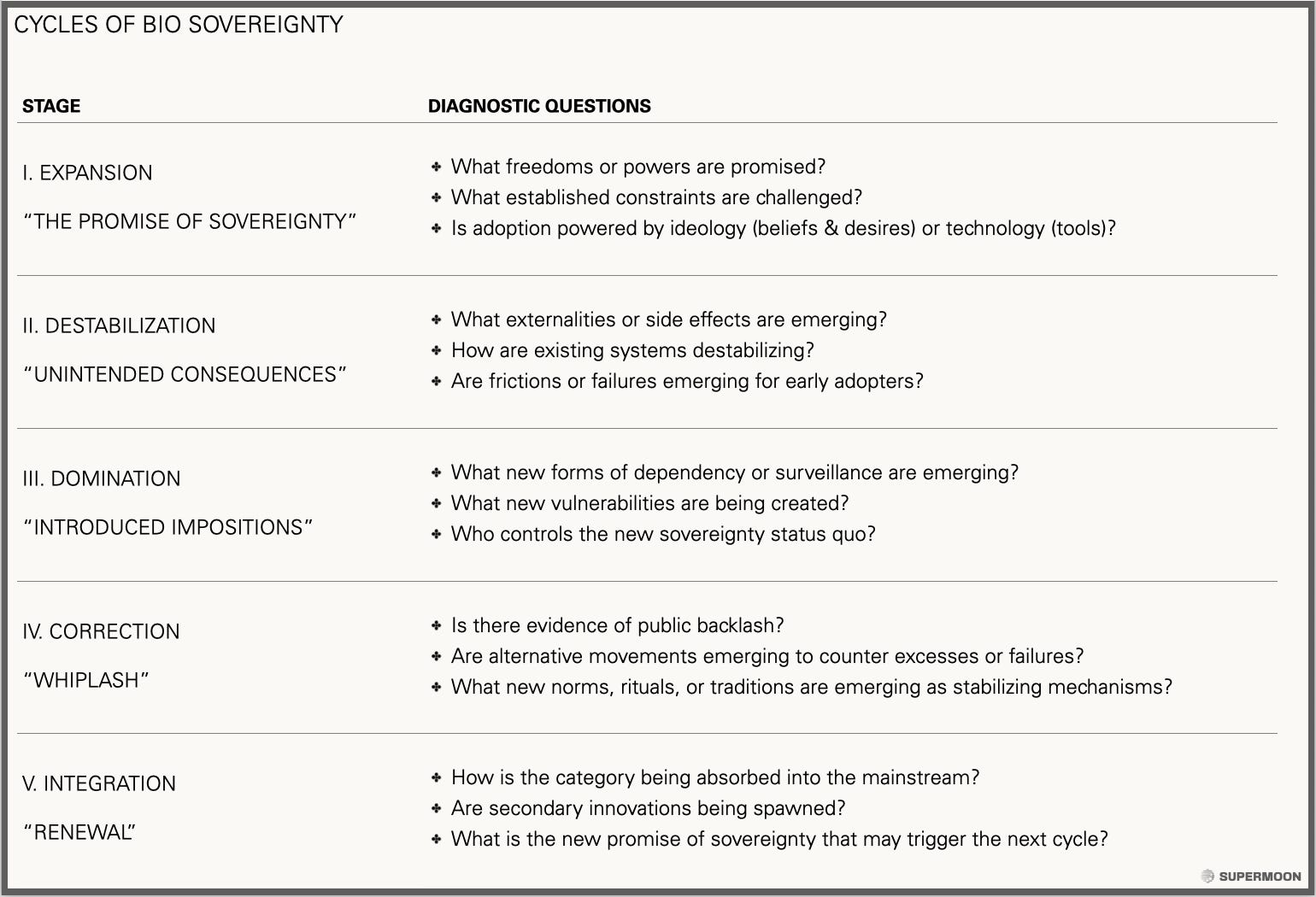
Case studies
Let’s use cigarettes and hormone replacement therapy (HRT) for menopause as two case studies to exemplify the cycle.
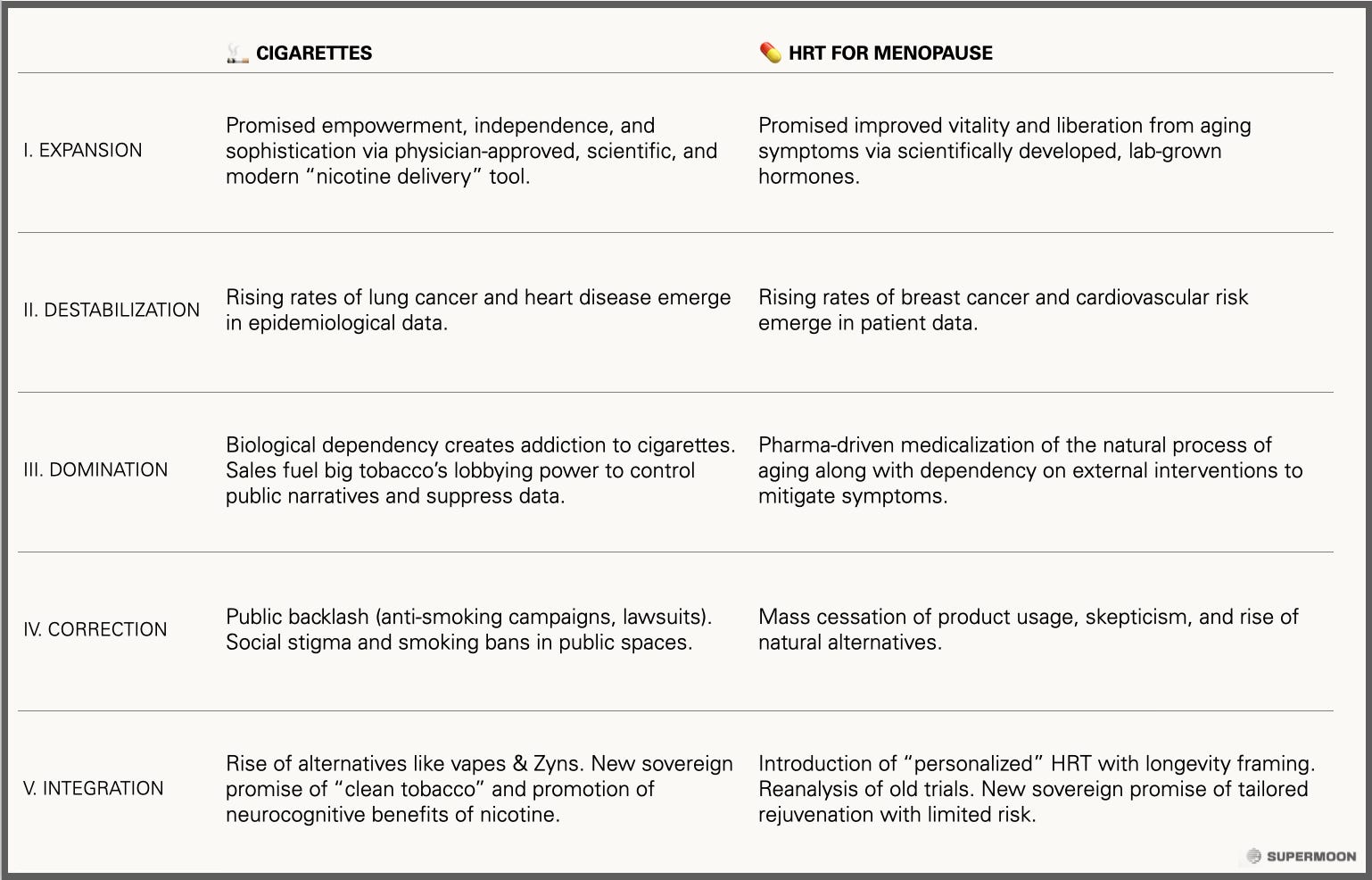
This arc plays out again and again throughout the history of medicine and spans procedures like bloodletting and lobotomies to pharmaceuticals like FenPhen and thalidomide.
The cycle is easiest to visualize when a safety failure underlies the destabilization stage as is the case for cigarettes, HRT for menopause, and the other examples above. But it plays out across safe medical innovations as well; new debates, inequities, or dependencies can surface not from safety risks but from economics, access, ethics, or cultural resistance.
Insulin and organ transplants are good examples of this.
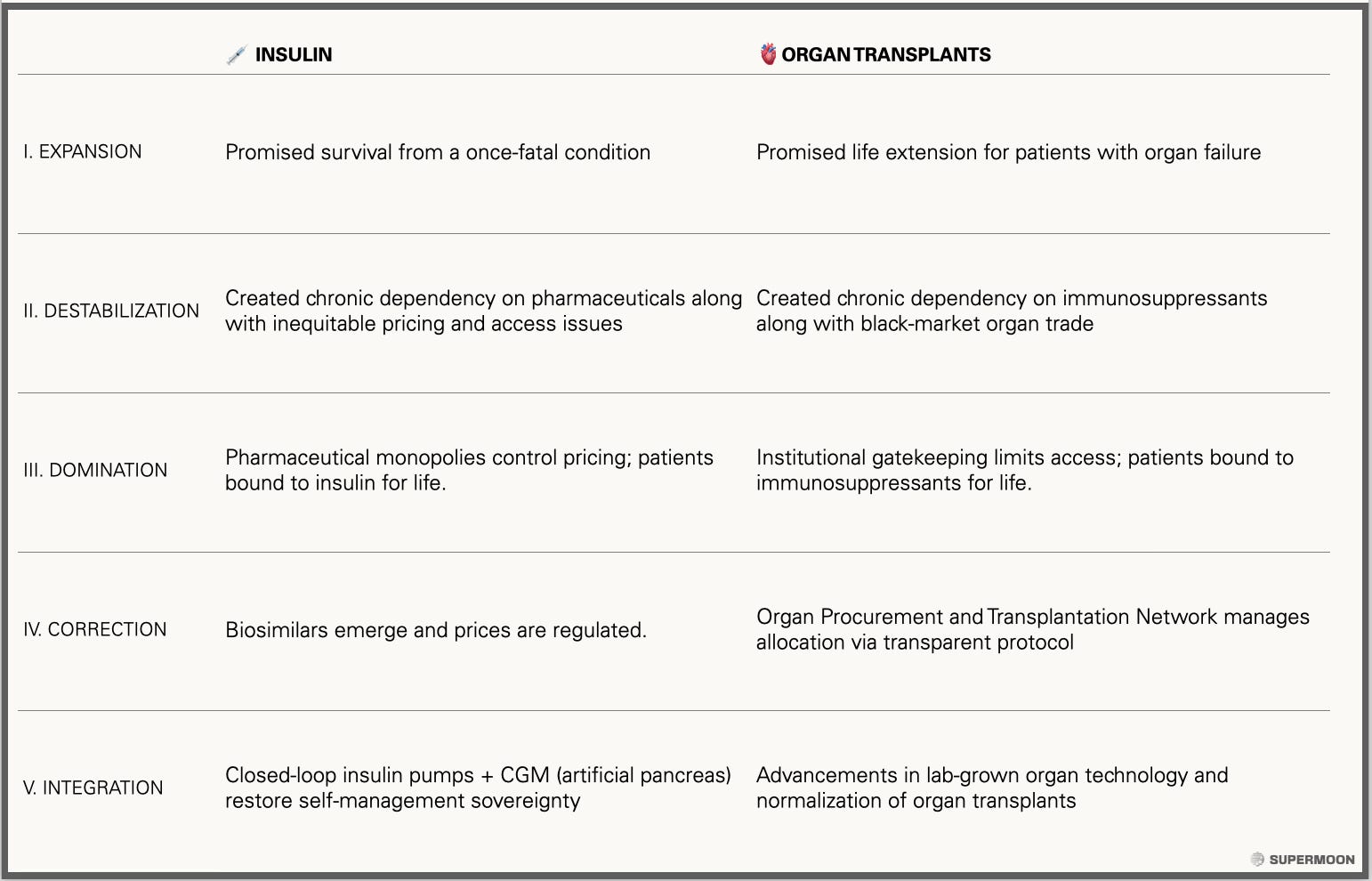
In both cases, patients trade pharmaceutical dependency for the promise of survival. A fair trade, I’d argue.
But from a venture perspective, the fairness of the trade itself is not important. What is important is acknowledging that every time we claim biological sovereignty we simultaneously spark new risks and constraints. Sometimes these are new health risks (as with cigarettes), other times they are new dependencies (as with insulin), and still other times they are new global concerns (as with cars and air pollution).
There will always be new value creation opportunities. Make sure you know where to find them.
Stay tuned to see where the health and wellness tools of today - GLP-1s, wearables, probiotic supplements, etc. - fall along the bio sovereignty cycle and learn how early adopters are already highlighting where future arcs will occur.
Supermoon is a research-driven VC that invests in scientists, technologists, and creatives building the future of sleep and sleep-adjacent categories. We invest globally in pre-seed to Series A stage businesses across enterprise, consumer, and biotech. If you’re building in sleep or are interested in partnering with one of our portfolio companies, I’d love to chat. You can reach me on LinkedIn and Twitter, or email me directly at gj@supermooncapital.com.
In the French revolution, this meant stripping hereditary privileges, redistricting political jurisdictions, dismantling feudal systems, and erasing monarchical images such as the fleur-de-lis while introducing a new calendar, flag, and judicial system.
Absolutely brilliant!
Interesting concept: biological sovereignty
Always enjoying your thought provoking takes and eloquent writing